

"Wizard" by Marc Seifer.
A Review of Nikola Tesla’s Inner Life, Genius, and the Lightning That Shaped Him.

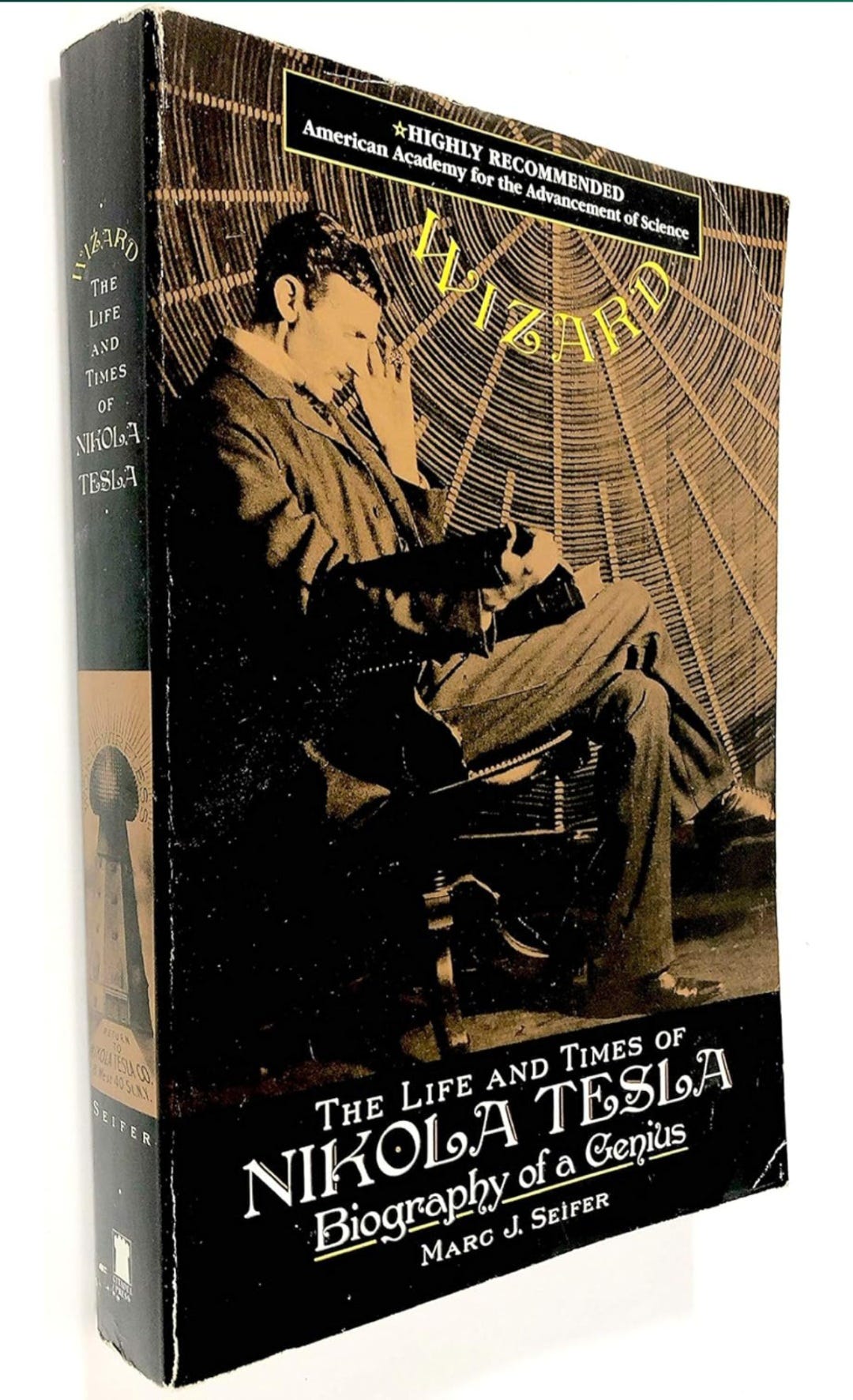
Marc Seifer’s, Wizard is not merely a biography of an inventor. It is a psychological portrait of a man shaped early by loss, illness, and an uneasy relationship with the human world he longed to improve. From its opening pages, the book announces that Tesla’s genius cannot be separated from his suffering. The prose invites the reader inward, not toward machines and patents first, but toward memory, grief, and the private storms that formed his character.
Tesla’s childhood emerges as the emotional engine of the narrative. The death of his older brother, Dane, casts a long and unrelenting shadow. Seifer presents this loss not as a footnote, but as a defining absence. Tesla grows up in the presence of comparison, striving for love and approval while measuring himself against an idealized figure who can never fail because he no longer exists. This quiet rivalry with a ghost becomes one of the book’s most haunting themes.
The trauma of witnessing his brother’s death appears to fracture Tesla’s inner world at an early age. Seifer carefully traces how this moment echoes forward, shaping Tesla’s intense inner life, his visions, and his sense that reality itself was unusually vivid and unstable. Rather than pathologizing these traits, the biography treats them as the raw material of his later brilliance.
Tesla’s near fatal bout with cholera becomes a pivotal turning point. The historical irony is striking. A society misunderstanding disease nearly loses one of its greatest minds. At the height of his illness, when death seems imminent, his father promises him the freedom to pursue engineering, a path Tesla had long desired. That promise reads as a lifeline. Seifer suggests that this moment binds father and son in a new way and gives Tesla a reason to survive. Recovery feels less accidental than purposeful.
The surrounding violence of war further deepens Tesla’s estrangement from ordinary life. Although he avoids direct military service, the images of brutality he witnesses leave a permanent mark. Seifer uses these experiences to illuminate Tesla’s later stance toward people and society. He expresses deep concern for humanity as a whole while remaining wary of individual human behavior. This tension is not presented as coldness, but as a protective distance born of disappointment and sensory overload.
Throughout Wizard, Tesla is portrayed as a man of oscillation. His moods, convictions, and energies swing between extremes. Seifer describes a mind that vacillates between certainty and doubt, discipline and excess, devotion and withdrawal. Rather than smoothing these contradictions, the biography allows them to stand. Genius here is not tidy. It is volatile, costly, and deeply human.
By the time Tesla reaches formal education, he already feels fully formed by invisible forces. Loss, illness, fear, and reluctant love have done their work. Seifer makes it clear that the laboratories and inventions to come are extensions of an inner life forged much earlier.
Wizard succeeds because it refuses to separate achievement from pain. It does not mythologize Tesla into something unreal, nor does it diminish his accomplishments by overemphasizing his struggles. Instead, it presents a man whose desire to help the world grew out of early suffering and a complicated relationship with people themselves. The result is a biography that feels alive, unsettling, and quietly profound, one that lingers long after the page is turned.
Even though Wizard was written years ago, it has lost none of its relevance or force. In an age obsessed with quick brilliance and polished success stories, Seifer’s biography invites readers to slow down and consider the long, difficult formation of a mind that changed the world. This is a book for readers who value depth over spectacle and reflection over myth. Revisiting Wizard now feels less like reading history and more like listening closely to a human voice that still speaks to ambition, suffering, and the complicated cost of genius.
🌹🌹🌹🌹🌹🌹🌹🌹🌹🌹🌹🌹🌹🌹🌹🌹
If you’d like to support my work in other ways, you could consider sharing a cup of tea or coffee with me 😁 ☕
Also, my book of short prayers to start your day right is available on Amazon for less than a fiver. Trust me when I say it is a routine that will change your life for the better.